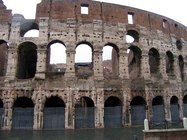
Other remains of the baths are visible several streets
away.

Australia: The Land Where Time Began
Baths of Diocletian, Rome
The grandest of the public baths, thermae, in Rome were the Diocletian Baths or Thermae Diocletiani. These baths, the largest, most sumptuous imperial baths, were dedicated in 306. They continued in use for 231 years until the Goths cut the aquaducts feeding them in 537, cutting the water supply to Rome's 900 baths. They are of similar size to those of Caraclla, and designed in such a way that the caldarium is on the southwest side so that it was heated by the afternoon sun, the frigidarium being protected from the afternoon sun.
Emperor Diocletian had the baths complex, the largest and most splendid in the world at the time, built probably to outdo Caracalla's baths, built almost 100 years earlier. Its capacity was about twice that of the Baths of Caracalla, allowing 3000 people at at a time. It was not just composed of baths, is also changing rooms, gymnasiums, libraries, meeting rooms, theatres, concert halls, sculpture gardens, vast basins for hot, lukewarm and cold plunges, as well as mosaic floors and marble facades. The bricks of the structure were covered with marble on the inside and marble-appearing stucco on the outside, appearing like the white marble of the Baths of Caracalla. The hugh central hall was the model for the Basilica of Maxentius in the Roman Forum.
Bathing
The bathing part of the complex consisted of 3 stages, the caldarium, the tepidarium and the frigidarium.
The Caldarium
The caldarium (aka Calidarium, Cella Caldaria or Cella Coctilium) was the first stage in a Roman bath house. This room contained a hot plunge bath, it was a hot room heated by underfloor heating, the hypocaust. The hypocaust consisted of a floor separated from the ground surface by short pillars, the pilae stacks, the space so formed allowing the heated air from a furnace, the praefurnium, to circulate under the floor and up the hollow walls fitted with ceramic box tiles that heated the room while venting the smoke and fumes through flues in the roof. Rooms requiring the most heat were placed nearest the furnace, the heat of which could be increased by adding more wood. The hypocaust, the forerunner of central heating, was labour and fuel intensive, so was restricted to villas and public buildings.
In about 25 BC Vitruvius wrote of their construction and design. He described how the heat was controlled by a ventilator in the domed ceiling and how a caldarium for men and women are built next to each other to use the heating more efficiently, and how the tempidarium was placed adjacent to the caldarium so the system would work more efficiently.
In the caldarium there would be a bath (alveus, piscina calida or solium) of hot water sunk into the floor and there was sometimes even a laconicum - a hot, dry area for inducing sweating. The bath's patrons would cover themselves with olive oil and use a strigil, a small curved metal tool, to remove the excess, scaping off the oil and sweat that also removed the dirt that the sweat cleared from their pores.
The Tepidarium
This was the warm (tepidus) room that was heated by the hypocaust system, where
there was radiant heat from the walls and floor.
An example of the tepidarium was found in the ruins of Pompeii that was covered by a barrel vault (aka tunnel vault or wagon vault). There was a series of square recesses around the room that were separated from each other by telamones.
In the Roman thermae it was the great hall visitors to the baths entered before moving on to the caldaria of the frigidium. It was lighted through clerestory windows and was the part of the complex where the richest decorations were placed.
The frigidium
This was a cold pool that was used after the caldarium and the tempidarium opened the pores of the skin to close the pores. It was either a small cold water pool or a swimming pool. In 2006 an octagonal example 5 m across was found near Faversham, Kent. The walls had been decorated with painted plaster and the floors with colured tesserae. It is the first pool of its type found in England. Some think it could have been used for Christian baptisms or Jewish sacred bathing.
Diocletian's co-emperor Maximian began construction of the baths when he returned from Africa in 298 on behalf of Diocletion who was based in Asia Minor. Dioletian is believed to have forced 10,000 Christians to work on the construction. In 1561 Pope Pius IV Medici commissioned Michelangelo to design a church to honour the Christians who died during the construction of the baths. In 1759 Luigi Vanvitelli rebuilt the Church of Santa Maria degli Angeli.
These baths were preserved from destruction and deterioration by being made use of for other purposes by succeeding generations. A rare glimpse of the splendid nature of the original Roman building is afforded by the 3 high transept vaults of the Basilica Santa Maria degli e dei Martiri, originally the tepidarium. Unfortunately, most of the complex has either fallen down or been pulled down. The curved line of the outer wall of the great exedra is followed by the Piazza della Repubblica.
Later uses foe the Bath Complex
The facade of the Basilica Santa Maria degli e dei Martiri is the curved inner wall of a partition of the original bath complex.
The Church of San Bernardo alle Terme
National Roman Museum
Part of the Museo Nazionale Romano - National Roman Museum - occupies the main hall and the octagonal aula. In 1889 Museo Nazionale Romano was installed in a small part of the original Bath to house works of art from ancient Rome.
Italian state funerals are usually held here. During the Christmas and
Easter seasons there are concerts of religious music.
-
| Home |
| Journey Back Through Time |
| Geology |
| Biology |
| Fauna |
| Flora |
| Climate |
| Hydrology |
| Environment |
| Experience Australia |
| Aboriginal Australia |
| National Parks |
| Photo Galleries |
| Site Map |